Showing posts with label Spay and Neuter. Show all posts

Tuesday, November 25, 2014

The High Cost of Pet Ownership

Saturday, Baby-Dog Woodrow ate a bar of soap for $140.75.  The bar of soap: 75 cents. The vet bill: $140. 

Our Woodrow is going to recover completely, perhaps because my soap is ninety-nine and forty-four one-hundredths percent pure.  (If you are over 60, you know what brand my soap is.)

Because of his Saturday indiscretion, Woodrow vomited three times on Sunday, so I fed him small amounts of rice and rice-water throughout the day. I skipped church to take care of him.  He slept most of the day, wanted me close.  I stayed on the bed with him for hours, whispering “I love you,” reading, and watching John Wayne movies. 

Although he woke me with lively kisses before dawn this morning, we were sitting in the vet office by 9:00.  
Woodrow’s Great Soap Escapade started me thinking (once again) about how much money adequate pet care costs.  And about how many people who have pets can’t afford to have them. 

While I was in the vet’s office, I overheard the receptionist talking to a potential client.  The woman had a voucher to have her dog spayed, and she wanted to know how much money she would have to pay the vet if she used it.  The voucher paid $45 for the spay surgery.  The owner would have to pay $20 for pain medication and $15-18 for something else (I couldn’t hear what).  The owner said that she didn’t want to pay for the pain medication or the required something else. 
The receptionist explained that the vet would not perform a spay surgery without pain medication. 

“Thank God,” I thought, having had a hysterectomy myself. 
Not only did I think about the cost of dog ownership at that moment, but I spent fifteen seconds wondering whether a lady who didn’t want to provide pain medication for her post-hysterectomy dog should even own a dog.

Please understand.  I personally know many people who dearly love their pets but who cannot afford their care.  I once knew a double-amputee military veteran who deeply loved his dog and almost died of a broken heart when she died. She died because he could not afford her monthly heartworm preventative.  Perhaps if I had known it before her death, I could have located a veterans’ organization who would have helped.  I hope she was waiting for him when he finally reached Heaven’s gates, and with his legs restored, he could run with her through sunlit meadows.
The truth is ugly, but people who want to adopt a pet need to understand that the cost of the adoption is only the tiniest tip of the iceberg of years of significant financial commitment.  Anyone who carries a credit card balance can’t afford a pet.  Breaks my heart because disposable income should not be a condition of giving and receiving the love of a dog.  Or a cat.  But caring for a pet is expensive. 

Love ought to be enough.  But it isn’t.


Saturday, October 25, 2014

On Loss and Gain: Shelter Dogs and Life Changes

Two days ago when we adopted our new dog, Laird Woodrow the Wirehaired of the House of Gore-Lancaster, I did something that gave me pause at first, but in retrospect, I know was right.

Woodrow, then called Jack, shared a cage with a female named Allie; she seemed a couple of years older than he.  They had wire-haired-ish faces, but different coloration and body builds.  She was snow white with a large brown patch; he was retriever gold with an eggshell muzzle.  She was taller and leaner, her face pointier, her mustache more pronounced. He loved people; she didn’t approach.

On the day we adopted him, the shelter attendant had to drag Woodrow-To-Be outside to meet us.  Long strings of fear-saliva flung from his whiskers, and he flattened himself on the walkway as she dragged him. I’ve seen roadkill less pancaked. “Sorry,” the attendant said.  “He’s not leash trained.”

I said, “He’s probably scared without his cage-mate.”

“Oh,” she said, “That’s his sister.” 

Whoa. “I didn’t know that,” I said.  “Petfinder doesn’t say they are pair-bonded.  I don’t want to break them up, and we can’t take them both. So we better not take him.”

“That’s the problem,” said the lovely young attendant, “People say exactly what you said; everybody thinks they’re cute, but nobody wants to separate them, so they don’t get adopted.”

“I understand that.”

“But the bigger problem is that they’ve been here over three weeks.  The shelter director has passed them over for euthanasia twice.  They’ll both have to be put down soon.”

“Oh.”

“If you take Jack, Allie has a much better chance of getting adopted.  If you take him, she might be saved, too.”

Oh, I thought.  If they stay together, they’ll almost certainly both be euthanized.  If I take him, he’ll be saved, and she might be euthanized.  But she might not.  At least she’ll have a shot at being adopted.  We might save both dogs by taking one.

Meanwhile, Woodrow cowered in front of us.  But our dog Callie liked him immediately; she play bowed.  That was the first criterion: Callie had to like him. Tenderhearted Husband Don liked him, too.  That wasn’t much of a hurdle because Don’s a softie for dogs.  Dad commended Woodrow as a charming fellow, so the deal was done.  Dog Pound Jack was to become our Woodrow.  Allie would lose her brother, but because of her loss, she would have a real shot at being adopted, too.

The Jack/Allie Catch 22 has led me to think about the need for sometimes letting go of people, things, and old roles in order to embrace new joys that life has to offer. You see, two objects cannot exist in the same space at the same time. And once a space is made available, something must fill it up. Because Nature abhors a vacuum. That’s physics.  And metaphysics.

This year, I’ve had to let go of my role as a college professor.  Sometimes it’s been a struggle.  But making that space has allowed me to regain a role I had to sacrifice long ago: now, in the autumn of my life, I can once again say, I am a musician. 

This year I watched a widow let go of her grief and become a beaming young lover once again.

I watched a shy, friendless old woman let go of her solitary life and move into assisted living where she has learned how much fun sharing a meal with new friends can be.

I watched a man let go of a home he could no longer care for and thereby find that freedom from homeownership pulses with possibility.

So losing something offers the possibility of filling the vacuum with something new, and perhaps in its own way, better.

So this is my prayer for Allie, whose brother I took from her yesterday.

Creator God, to save our Woodrow, I have forced dear Allie to give up her brother.  I beg that Thou wilt transform her loss into gain; I beseech Thee to send her a person who will shower her with the love that we pledge to shower upon her brother.  And Lord, I beseech Thee to embrace with Thy peace all the dear shelter dogs who this day must die because they have no one to love them.

Amen.    


Friday, October 24, 2014

The Transformation of a Shelter Dog: Laird Woodrow the Wirehaired of the House of Gore-Lancaster

Until yesterday,                        23 October 2014, at 3:00 p.m. CST, this was Jack, an innocent dog-person condemned to die through the fault of irresponsible human-persons: first and foremost, the human-person who owned Jack's mother and failed to spay her; second, the human-person who owned Jack's father and failed to neuter him; third, the human-person who abandoned him.  These perpetrators may have been  three separate irresponsible human-persons, or they may have been one human-person whose crimes of irresponsibility are manifold. Shame on the guilty for bringing more unwanted dog-babies into the world when 6.3 innocent dog-babies are already born for every innocent human-baby. 

However, yesterday at 3:01 p.m. CST, Jack's fate was transformed by the magic of love: Jack the Condemned to Die Through No Fault of His Own became Laird Woodrow the Wirehaired of the House of Gore-Lancaster.  This transformation required only a few swipes of the pen, $55, and a lifetime commitment of love, time and money from the whole fam-damily. 

Our Woodrow will be a dog-person adored from this day forward, although his adopted sister, Lady Callie (now 70+ in dog years), will see that he remains Second Dog while she remains Top Dog.

But appearances are often deceiving, and magic often produces results other than what we intended.  So here's the story.

Woodrow had sat on death row for more than three weeks; his cuteness factor gave him extra time while his kennel mates met their untimely ends.  His bio on Petfinder.com said he was an adult, and I'd been laboring under that misconception for two weeks. Yesterday, however, the shelter employee said he was six to eight months old, so I thought, O.....kay. Well, he's pretty close to full size.  But the vet told me three minutes ago that he is only four months old and is going to get twice as big.  He's gonna be a bonny, strapping boy.  Not exactly what I had in mind, but apparently what God did.  "Ha HA!" said God.  Who happens to be the Ultimate Magician.
 
So Laird Woodrow the Wirehaired, my 30-pound dog-person, will become my 60-pound dog-person.  But that's okay.  Twice as much dog for the money. Twice as much magic.  Twice as much love.  Darn good deal if you ask me. 

Sunday, September 14, 2014

Tales from a Spay and Neuter Clinic: An Overview


Tales from a Spay and Neuter Clinic: An Overview

Arkansans love animals.  Arkansas is #1 in dog ownership in the nation, #7 in pet ownership.  Unfortunately, it’s also 48th in median family income. 
People in the hills of west-central Arkansas are the folks we serve in our mobile spay and neuter clinics.  Good, honest, hardworking people.  Help their neighbors.  Many were not able to finish high school.  Many are functionally illiterate. Many are disabled.  They live in poverty.  But they try to help animals.


These good people can barely feed themselves, but they give of what little they have to care for the endless stream of injured, frightened, abandoned puppies and dogs who collapse on the roadside after they've been thrown out of a moving car on the county road. Or abandoned by a desperate neighbor who moved away. 

They bring freezing kitties out of the winter night, kitties who are trying to warm themselves on a car engine, or who come to their doors anemic from ticks and fleas.

They feed colonies of skinny feral cats and watch helplessly as they multiply exponentially. 

These are the people and animals the Hot Springs Village Animal Welfare League Spay and Neuter Clinics help.  Not the middle-class people of Hot Springs Village; the people in the poverty-stricken areas around it.

The League offers four 2-day mobile spay and neuter clinics a year in Mountain Pine, Fountain Lake, Crows, and Jessieville.  Jessieville’s not on the census.  Crows isn’t even on the map.  But people live there.

The League contracts with Arkansans for Animals, a nonprofit that runs a mobile clinic and keeps it staffed with a vet and two assistants. But a hundred volunteers are needed to make each two-day clinic run smoothly.

League members post signs advertising the clinic, but word of mouth from former clients is the most powerful advertisement.  People call their neighbors, go tell their friends who are sitting on their porches, knock on doors of folks who don’t get out much.

Then, the first day of the clinic, people start coming.  The return clients are confident and excited.  The new clients are tenuous, anxious.  But down the road they come, leading big and little dogs of every ilk: shepherd mixes, pit mixes, small purebreds dumped by puppy millers, whole litters of half-grown pups.  From their battered old cars, they unload crates full of the community cats and kittens they feed. 

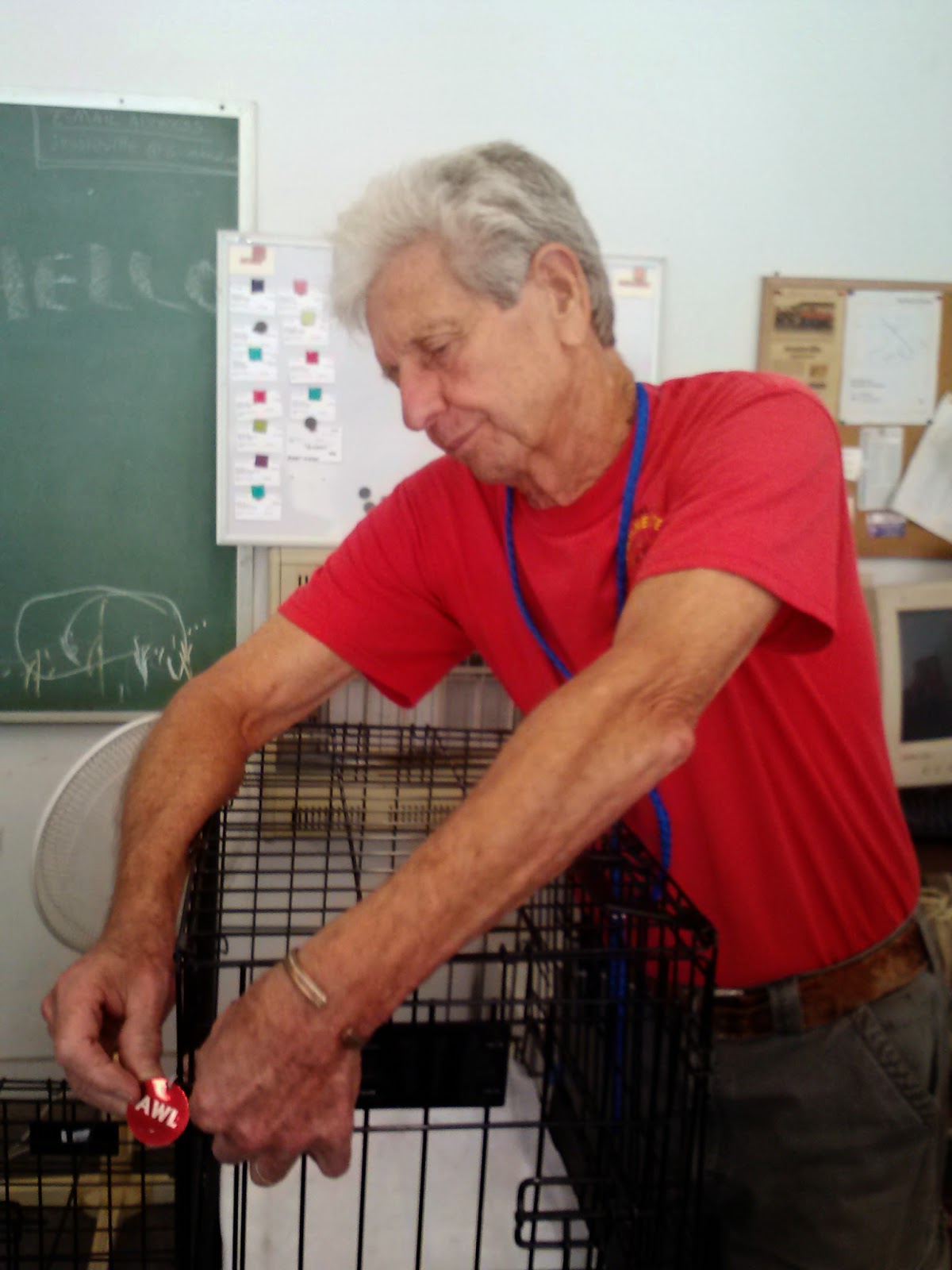
Red-shirted volunteers go into action.  They complete paperwork and process whatever fee the clients can pay.  Other volunteers crate the animals and comfort the frightened ones. 

More volunteers schedule the order of surgeries and carry the animals to and from the mobile operating room.

When the volunteer cooks arrive with food and water at noon, those on the front line grab a sandwich and a drink on the fly.

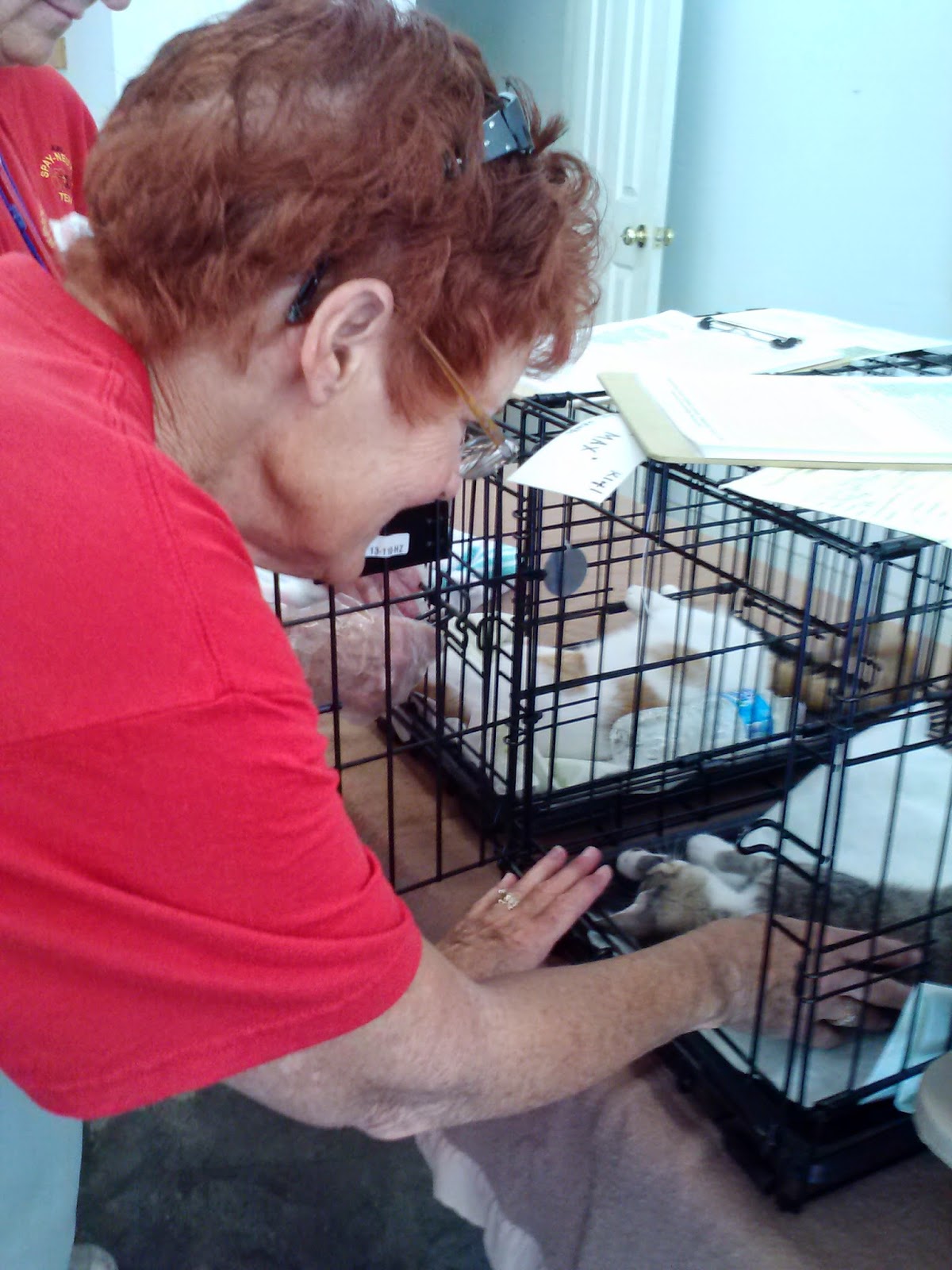
Good Samaritans stay one-on-one with animals as they begin to recover from surgery, talking to them, stroking them, reassuring them.  Owners who arrive early are allowed in the recovery area to comfort their animal family member.  Volunteers give pedicures to sleeping animals who need them, check them for fleas and ticks.

Nurses and a retired vet check every animal and stay close to those having cardiac or breathing problems.  Experienced volunteers massage and talk to animals having difficulty awakening.

Owners receive education and counseling as they arrive to claim their dogs and cats.  They receive gifts of food and other pet supplies.  They thank the volunteers over and over.  “You don’t know how important this clinic is,” they say as they gather their beloved animal companion to head home.  "You don't know how much this community needs you. You make such a difference in our lives.  We don't know what we'd do without your help. We don't know what our animals would do." 


Saturday, September 13, 2014

Spay and Neuter Clinic Tales: Who, What, Where, How, and Why


Spay and Neuter Clinic Tales: Who, What, Where, How, and Why

Hot Springs Village Animal Welfare League doesn’t need to provide spay and neuter services for Hot Springs Villagers.  The Village is a gated community of retired middle-class people (mean income $51,502) who pamper their companion animals. 

When Villagers die or must move into nursing homes, The League steps in to help rehome beloved animal companions.  The League provides world-class care for animals who wander into the village as strays or are dumped off here in the middle of the night, sometimes injured or ill, and that happens more than you might think.  The League manages a no-kill shelter with six runs, a beautiful play yard, and plenty of volunteers.  A strong foster program is a mainstay of The League, and the foster families helped The League adopt out 301 animals in 2013. 

What makes The League unique is that they focus on providing spay and neuter (S/N) mobile clinics for their good but poverty-stricken (approximately $13,000/year) neighbors who live in rural areas surrounding The Village.  These good people rescue stray and abandoned animals, but they cannot afford to take the animals to veterinarians to have them spayed and neutered.  The people pay the clinic what they can afford, but they can’t afford much.

Let me say that again: The League does not provide S/N clinics for The Village; they provide desperately-needed services for their non-Village neighbors who cannot afford to spay and neuter their rescued cats and dogs.

Yesterday I drove around one of the stunningly-poor unincorporated towns where a two-day clinic would begin today at the fire station.  The town isn’t even on the census.  The world has forgotten it.  Even the stop signs are faded to white.


As I drove through the run-down, unpainted houses and the trailers with tape across the cracked windows, I waved to people sitting on their porches. A lot of people were sitting on their porches because nobody can afford air conditioners.  The 90 degree heat outside was cooler than the 110 degree heat inside.  But despite the oppressing heat, everyone I waved to waved back. 

Many of the dogs in this hamlet live in desperate situations. My heart broke when I saw this heavy-coated husky mix chained to a tree with only rocks and dirt for comfort.  Panting, he had plastered himself against the side of his owner’s mobile home trying to feel the little coolness that might remain in the corrugated tin.  Today the heat will get to 90.  He probably won’t die, but he might wish he could.  When I saw the BEWARE OF THE DOG sign on the tree to which he was chained, I started to cry.  The sign should have said BEWARE OF PEOPLE. 


But most of these desperately poor people love their dogs and cats and want to take good care of them.  I passed a young woman who was carrying a small Sheltie, pushing her baby in a carriage, leading a Westie, and ushering along her other two little girls.  I stopped and asked whether she was headed to the clinic.  She said she was.  I asked whether I could take her picture.  She said I could. 
 

I explained that since Bob Barker died and the board closed his foundation, we had lost a significant part of our S/N funding, and I was trying to write grants to help continue the clinics.  She said, “Thank you so much. I can’t afford to take these dogs to the vet.  I rescued them this week from a lady who had rescued them from a puppy mill.  They stunk and were covered in ticks that took me all evening to pick off after I bathed them.  So now I have to get them fixed so they don’t have any more babies.  I think this one’s already pregnant,” she said, nodding at the one she was carrying.


Then she said, “I don’t know what would happen to the dogs here if you had to stop doing this clinic.  Thank you so much.  It’s really important.  We need so much help… You don’t even know…” 

She’s the kind of good folks that The League is trying to help.  But we need money to carry on the work.

After I left her walking down the road, I went to the clinic to see what I could see.  The dogs were all ages and sizes, from a big, grown blue-eyed husky, to a nervous adult Chihuahua, to a frightened puppy, to a rambunctious bunch of year-old mixes of all colors and coats with one blue and one brown eye.  I figured the husky was the source of all those youngsters and countless more.


My heart filled with pride as I watched our President Mary, a former nurse, listen to an unconscious kitty’s heartbeat; our Spay and Neuter Coordinator, Angela, comfort a kitty who was trying to awaken from the anesthesia; and a man I never saw before tag a cage for the next patient.


These wonderful people (and 96 more) could have been home savoring a second cup of coffee over a good book, playing a round of golf, or sleeping in.  Instead, they were helping animals in need.  Not their own animals, but the animals of a community who lacked the money- and often education- to take care of the needs of its own dear dogs and cats.

But volunteers can’t pick up scalpels and operate on dogs and cats.  They can’t perform spay and neuter surgeries.  For that we need vets, mobile clinics who will come to these poverty-ridden locations and provide the services that the animals so desperately need.  For that, The League needs money: $5000 for each two-day spay and neuter clinic so young ladies who try to rescue neglected dogs can walk down the road to get help for them.  So big blue-eyed huskies can stop multiplying endlessly.  So maybe, just maybe, dogs chained to trees in the searing heat under signs that scream BEWARE OF THE DOG will become only a distant memory.


Thursday, September 11, 2014

Spay and Neuter Clinic Tales: Good Neighbors


Spay and Neuter Clinic Tales: Good Neighbors

I thought Maggie was Tom’s mother when they came in to the clinic together.  Tom’s two dogs were out of surgery and in recovery, so I asked Maggie if I could talk to her while Tom completed the release forms. 

“You’re his mom?” I asked, certain that she was.

“Oh, no!” she said, “I’m just his neighbor.”

“How did you happen to come here with him today?”

“I brought one of my cats in yesterday and told Tom that he needed to bring his dogs today.  I told him that you’d help him.  He came right down and you gave him a voucher for today.”

I asked Maggie to tell me about her cat.  “I’m a cat person,” she said, “So when I heard a sound from under the hood of my car this spring, I knew what it was.  I opened the hood, and there the little thing was, curled up on the engine.”  Then she added, “I’ve been waiting ever since for your clinic so I could get her fixed like my other two cats.  I gave you my ten dollars.  Then I gave you another ten dollars to fix my down-the-street-neighbor-Alice’s cat.  I told Alice that she needed to get her cat fixed, and she said she couldn’t afford to.  So I told her to come here and I’d pay the ten dollars.  So she did, and I did.”

I asked Maggie about Alice’s cat.  She said, “People moved away and left it.  So Alice started feeding it, and now it’s hers.”  Then she added, “You gotta keep cats here inside.  People will kill ‘em.  Big dogs run loose and will kill ‘em, but people will kill ‘em, too.”

I asked Maggie about Tom’s two dogs.  “Tom’s out of work, so he rented a room from my neighbor girl.  She works two jobs and rents out bedrooms to make ends meet.  She works real hard.  The woman who rented out her other bedroom just moved out a month ago and left her two dogs, a male and a female.  Never came back for ‘em.  Tom started taking care of ‘em.”

“Wow,” I said.  “Sounds like a lot of people around here move off and leave their animals.” 

“They do,” she said.  Then she added, “Most of the neighbors are good people who try to take care of animals.  But some are bad people.  There’s some bad people here.  Drugs and illegal substances.  And they let their dogs run loose.  And they kill cats.  They don’t like cats.  They killed my cat Sally this year.  I think it was teenagers.”

I asked her about Tom.  She said, “He’s been out of work for a long time.  But he’s a good person and works hard.  He tries to help everyone in the neighborhood.  He’ll do anything to help anybody.  People are really poor here, but we all try to help each other.”

I asked her what the clinic meant to her, told her that I was writing a grant to try to keep it going because we’d lost our Bob Barker funding.  First she looked alarmed and said, “I already gave my ten dollars, and then ten more for Alice!  I’m on disability.  I can’t give any more!”

I assured her that I didn’t want her money.  I explained that I was writing grants for places like the ASPCA and Best Friends.  Then she said, “Maybe I could help you.  Let me give you my phone number.  I’ll do anything I can to help.”

I told her that what I needed her to do was tell me if the clinic had made a difference in the community, and how she knew if it did.  She said, “I used to see seven, eight stray dogs every week.  Now I hardly ever see a stray.  Dogs run loose, but you know who every dog belongs to.  We don’t have strays any more since you started these clinics.  Your clinics make a difference.  They make a BIG difference.   The people here need ‘em.  You’ve got to get the money to keep ‘em going.  I’ll help you any way I can.  Just call me.”  She reached out for my notepad and wrote down her name and phone number.  “Just you call me,” she said.  “I’ll do anything I can to help.  Just you call me, and I’ll help.”

Thanks, Maggie.  You’ve already helped than you’ll ever know.

Spay and Neuter Clinic Tales: Sweet Nothings


Spay and Neuter Clinic Tales: Sweet Nothings

Al got laid off from his job in the oilfields out west last November.  Finding another job is especially tough for Al.  He has no teeth -none- and tattoos down both arms.  When I asked him about his tattoos, Al said, “I was young and dumb.” Then he pointed to a hand-drawn sun. “Just 13 when I got this one.  I’d do anything to get rid of them all.”  He added, “They make it harder to find a job.”

Al and his wife have a two-year-old son.  His wife is pregnant, and they found out yesterday that the baby girl may have spina bifida.  If she does, she will be paralyzed below the cleft in her spine.  I didn’t tell Al that.

I don’t think Al can read, and I think he has problems processing verbal information, too.  He loves his dog, Jack, but although we told him not to feed Jack breakfast before his neutering surgery, he did.  We had to reschedule Jack for the last slot of the day.  When Al arrived to pick Jack up and we told him that Jack was in surgery because he’d been fed breakfast, Al stood quietly in a corner and waited patiently until he could join his dog in the recovery area.  I explained to him how a dog -or a person- could die from stomach food coming up and getting into the lungs during surgery.  He hadn’t known that. 

Al’s neighbors moved away three months ago and left little Jack behind.  Just left the dog in the yard and moved away.  Al and his wife took Jack in.  I asked Al why he wanted to neuter Jack.  He said, “Lots of big male dogs run loose around here.  I was afraid a female would come by and little Jack would get hurt by the big dogs in a fight.”

I told Al that I was writing a grant for money to fund future spay and neuter clinics and asked if I could take his picture and tell his story.  Al’s eyes grew wide and he said, “I don’t have any money!  I’m out of work!” 

I said, “I don’t want any money from you, Son.  All I want is to take your picture with Jack and tell people your story so they can understand why we need money to keep this clinic going.”

“Oh, sure,” Al said, relieved.  Then he joined little Jack in the recovery area and whispered sweet nothings in his ear until he could take the little guy home.

Tuesday, August 12, 2014

Callie: My Big, Black, Mixed-Breed Shelter Dog


Callie is my big black dog.  My big, black, mixed-breed, shelter dog. 


Six years ago, my grad students and I started the first-of-its-kind comprehensive support program for fully-academically-qualified college students with Autism Spectrum Disorders (ASDs). The university gave us a house on campus and scholarship money for the peer mentors who would work with our students with ASDs.

When we accepted our first student, her mom told me, “She needs a dog.  She can’t go to sleep at night unless she spends time grooming her dog first.”

“Okay,” I said.  I knew I’d never get permission to have a dog living on campus, so I forged ahead.  Easier to get forgiveness than ask permission.

I called The Clay County Animal Shelter in Henrietta, Texas.  I told Annie Boddy McClintock, “I need a big black dog to live in a house on campus with four college students who have ASDs and their three nondisabled peer mentors.  It’s now March 15.  I need the dog August 15.  Pick me out the right dog for the job.”  I hung up.

Annie got to work. 

I called her August 14.  Said, “It’s time.”

She said, “Come to the shelter tomorrow.  My staff and I’ve been studying the dogs all summer.  We have five big black dogs for you to choose from.  One has risen to the top of all of our lists, but we want you to make the final choice.”  I asked which dog had risen to the top of their lists. 

“I’m not going to tell you,” she said. 

My husband, Don, went to the shelter with me the next day.  We sat down in the dirt, and the staff gathered to watch.  I could tell they were nervous.  One staff member brought us the first big black dog.  He sniffed us in greeting and then ran off to dig a hole.  “Nope,” I said.  “I’m gonna be in enough trouble for bringing a dog to live on campus.  Can’t have a hole-digging dog.”

Second dog sniffed us in greeting and then hunched up and pooped right in front of us.  “Bad manners,” I said.  “We need a dog who will housetrain immediately.  This does not portend well for that.”

I don’t remember what the third dog did, but I eliminated it.

The fourth dog sniffed us a greeting and then ran off to talk to other dogs.  “Nope,” I said.  “Our dog has to be more interested in people than other dogs.”  Four down, one to go.

The fifth dog was Callie.  Six months earlier, three cowboys had found her trotting along a dusty road, dirty, emaciated, and dehydrated.  And VERY pregnant.  They picked her up and brought her to the shelter where she delivered four babies three days later.  The shelter staff named her Calamity Jane in honor of the cowboys.  They called her Callie for short.

When the handler turned Callie loose for us, she ran right up to us, sniffed at us, gave us a nice lick… and then turned her back to me, sat down, and scootched up to me to push her back full-length up against my side.  She sat quietly, attached to my side like a second skin.  I looked up at the assembled staff.  Their faces lit up like dawn on the Texas desert.

“This is the dog,” I said.  The staff cheered.

Callie moved into the campus house. The students continued calling her Callie but changed her formal name to Calliope, the Greek muse of music.  They didn’t think Calamity Jane fit such an elegant dog.

We enrolled her in obedience class.  She finished top of her class.  Then we enrolled her in intermediate obedience.  Top of her class again.  Big, black, mixed-breed, shelter dog.  Best in class at sitting, staying, shaking hands, downing, coming, releasing, and perhaps most important, “leaving-it” alone, whether a dead bird, a kid on a bike, or another dog.

Callie became famous.  The university newspaper published a front-page article on her.  Ditto our university magazine.  I got in trouble for bringing her on campus, but I expected that.  Armed with the research about the effects of dogs on students who have ASDs, I was able to convince the housing administrator to let her stay. Bad PR and all that, you know.

Callie read our students with ASDs like an open book.  When someone began to escalate ("melt down" for people who use that term), she sensed it, trotted over, sat down, and offered them her paw to shake.  Alternatively, she turned her back to them, scootched up against them, and sat on their feet.  Either way, she derailed the escalation and restored the peace.

The boys in residence slept in the bedroom upstairs, the girls downstairs; Callie slept with the girls.  The only time she aggressed was one Saturday morning.  The father of one of our girls had come to take her home for the weekend.  He knocked and knocked on the front door, but nobody answered.  He tried the knob, and it was unlocked.  He tiptoed down the hall and opened the door to the girls’ room.  Callie bolted upright, roared like a lion, and sprung at the intruder.  This man was NOT going to touch HER girls! Scared the poor dad to death, but reassured us all that she was going to take care of her family.

Three years later, when Callie was six, the university closed our program.  No fault of Callie’s.  She missed her college students, but she came to live with Don and me, so now she takes care of us.  She’s an old lady, seventy in dog years, but she still has the shiny, sleek coat of a young dog.  Callie, my big, black, mixed-breed shelter dog who went from being Calamity Jane to Calliope, the Greek muse of music.  First in her obedience class.  Autism specialist.  Changer of lives.

Thank you, God, for Callie.  Thank you for the gift of big, black, mixed-breed, shelter dogs.  Alleulia and Amen.

.

Saturday, August 9, 2014

DiMaggio, The Dog at Home Plate


His name is DiMaggio.  I don’t know who named him, but all the locals know who he is.  He’s big, and dark, and of uncertain parentage.  I wonder if he’s lonely.

He lives next to the baseball diamond, north of home plate.  Actually, he also lives behind the restaurant called Home Plate.  He lurks back in the forest.  Sometimes I glimpse him peeking out. Sometimes I see him standing boldly in front of the trees. But the one time I tried to approach him, he melted back into the woods and never reappeared.  I watched for him throughout my salad, entrée, dessert course, and one last cup of coffee. But he didn’t show himself again.

Arkansas has lots of homeless dogs.  Last week, a dog appeared out of nowhere in front of my car and then slid into the tall grass by the highway, but not before I saw her teats, hanging low, but not plump with milk.  I hoped she had found something to eat and drink.  I wondered how many of her babies would live.  And what would become of them if they did.  Wish I could have brought them all home.  But I couldn’t.

But back to DiMaggio. 

He doesn’t have a family, and I wonder if he’s lonely.  But he does have a house.  Some good Samaritan built him a doghouse.  Nice doghouse.  Man just did what he could do to help a homeless dog.

And DiMaggio has enough to eat.  Local folks bring him food, and every night, the manager of Home Plate takes him a feast: scraps of steak, liver, catfish fillets.  Some black-eyed peas and hush puppies.  Maybe a taste of apple pie. Not the healthiest of diets for a dog, but delicious fare nonetheless, and enough to fill his belly. 

Good people live here.  Too many homeless dogs to care for, but good people doing what they can for this one homeless dog.

Wish I could bring him home.  Wish I could bring them all home.  But I can’t.  For every human baby born in America, 6.3 puppies are born: 4 million human babies, 25 ½ million dog babies a year. 

I don’t know if we’ll ever become a “spay and neuter nation” and stop the madness.  I don’t know what’s going to become of all the dear, homeless dogs.

But for now, for today, I will be thankful for the good people who built a doghouse and feed one homeless dog every day.  DiMaggio.  The dog who lives north of the baseball diamond behind Home Plate café.  DiMaggio.  May the Lord bless you and keep you.  And the people who do the best they can to care for you every day.